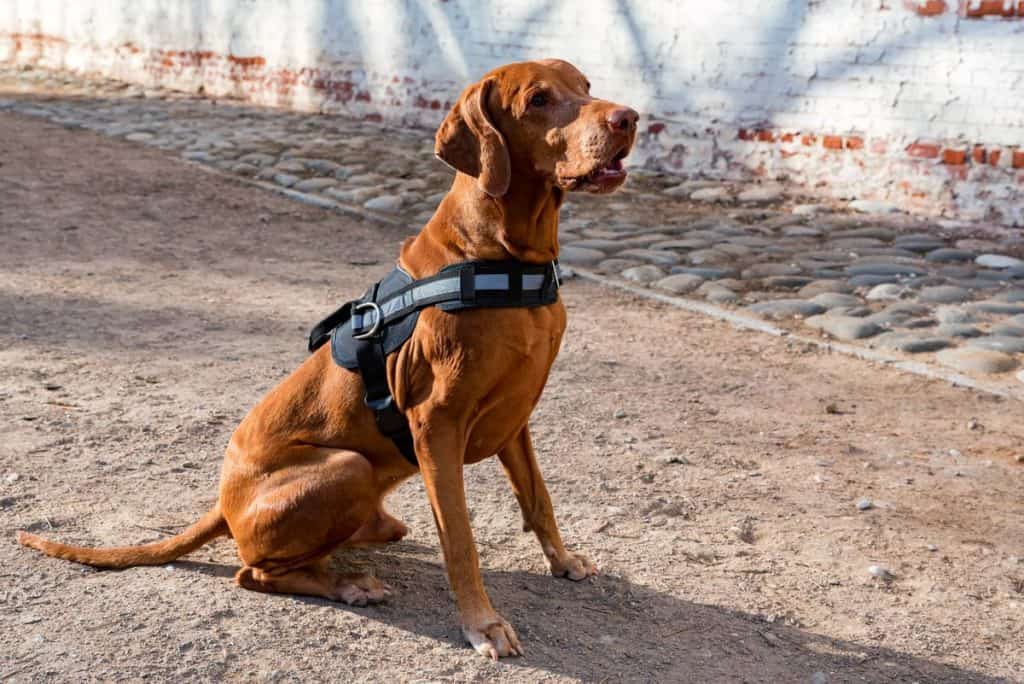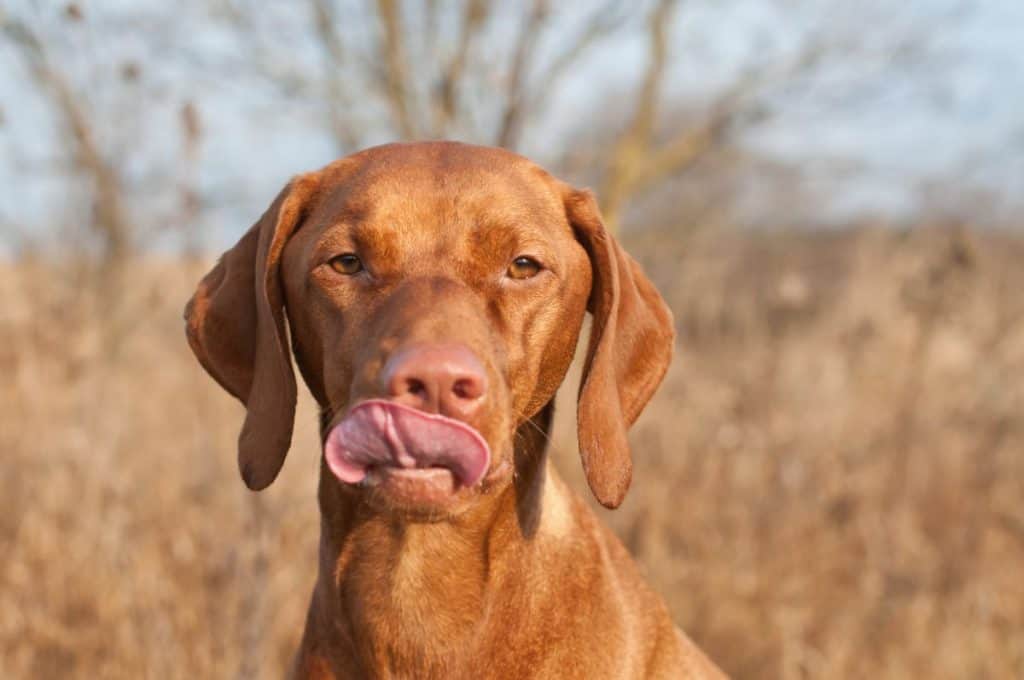
The official Vizsla eye colour standard
The American Kennel Club (AKC) breed standard for the Vizsla is precise on this point: eyes should be “of medium size and depth of setting, neither protruding nor deeply set. The iris should be of sufficient darkening in conformity with the coat colour.” AKC
In plain language, the eye colour should harmonise with the coat, a darker rust-golden coat warrants darker amber or brown eyes, while a lighter coat allows for more golden tones. The goal is visual cohesion: the Vizsla is a breed defined by its uniform golden-rust appearance, and the eyes are expected to complement rather than contrast with that.
Do Vizsla puppies have different eye colour?
Yes, and this is where most owners get confused. Like virtually all dog breeds, Vizsla puppies are born with blue-grey eyes. This is completely normal and not an indicator of the adult eye colour to come.
The blue colouration is caused by a lack of melanin pigmentation in the iris at birth. As the puppy’s body begins producing melanin, the eye colour transitions toward the warm golden or amber tones typical of the breed. This process follows a fairly predictable timeline:
wks
wks
wks
mths
mths
Some individual Vizslas take slightly longer. Reports from owners suggest occasional puppies whose eyes are still transitioning at 9–10 months, though this is less common. If your Vizsla’s eyes remain blue past 6 months, a vet check is a sensible precaution, though it may simply be slower maturation rather than a health issue.
Why do Vizsla eyes blend with their coat?
This is one of the more striking features of the breed. Unlike many dogs where contrast between coat and eye colour is desirable, think a black Labrador with yellow eyes, the Vizsla breed standard actively seeks conformity. The intent is a dog that looks uniform in golden-rust colouration from snout to tail, with no jarring contrast between features.
This is why a Vizsla with very dark, almost black eyes would be considered off-standard, and why pale or icy blue eyes represent a significant fault. The breed is essentially a study in monochromatic elegance, every shade from nose leather to eye colour is meant to exist within the same warm golden-rust family.
Vizsla eye colour vs. similar breeds
| Breed | Typical eye colour | Notes |
|---|---|---|
| Vizsla | Golden to dark brown | Must blend with rust-gold coat per standard |
| Weimaraner | Light amber, grey, or blue-grey | Blue permitted in puppies; grey preferred in adults |
| Rhodesian Ridgeback | Dark brown to amber | Should harmonise with coat; darker preferred |
| Hungarian Wirehaired Vizsla | Dark brown | Slightly darker standard than the smooth-coated variety |
| German Shorthaired Pointer | Dark brown | Lighter shades a fault; dark strongly preferred |
Can a Vizsla have blue eyes?
Adult Vizslas with blue eyes are extremely rare and not recognised by the AKC or FCI breed standards. If an adult Vizsla has persistently blue eyes, it could indicate:
- Mixed breeding, a blue-eyed ancestor (such as a Siberian Husky or Australian Shepherd) in the bloodline
- Incomplete pigmentation, occasionally linked to the merle gene if crossbreeding has occurred
- Subalbinism, a rare, partial lack of pigment that can affect eye colour along with coat and skin
A purebred Vizsla with blue eyes at adulthood is a significant deviation from the standard. This would not disqualify the dog as a pet, but it would be a disqualifying fault for conformation showing.
Eye health considerations for Vizslas
Eye colour itself is not a health concern, but Vizslas as a breed do have some conditions worth being aware of:
Frequently asked questions
Key takeaways
- Adult Vizslas have golden yellow, amber, or dark brown eyes, always warm tones that match the coat
- Puppies start with blue-grey eyes that shift to amber from around 6–8 weeks; colour is settled by 12 months
- The AKC requires eye colour to harmonise with the rust-gold coat, contrast is a fault
- Blue eyes in an adult Vizsla are not standard and may indicate mixed breeding
- Eye colour itself is not a health concern, but Vizslas are prone to PRA, always ask breeders for eye clearances